
Mississippi DPS Permit Practice Test 5
Test 5 of 10. Pick an answer for each question to see if it is right and why; your score appears at the end. You need 24 correct answers to pass, the same ratio as the real Mississippi test.

- Questions30
- Correct to pass24
- Passing score80%
- Minimum age15 years
-
1. Under Mississippi's safety belt law, which occupants of a passenger vehicle must wear a properly fastened seat belt?
Show answer
Answer C: Every occupant, whether in the front seat or the back seat
Mississippi law requires the driver and every passenger to wear a properly fastened safety belt regardless of seating position.
-
2. Which conviction requires the Commissioner of Public Safety to take a Mississippi license away for one year?
Show answer
Answer B: Three reckless driving convictions within a twelve-month period
Mississippi requires a one-year revocation for three reckless driving convictions within twelve months, alongside offenses such as negligent homicide and failure to stop and render aid.
-
3. A line beside your lane is painted about twice the normal width. What does the extra width convey?
Show answer
Answer B: Greater emphasis on the restriction it carries
Width is part of the marking code: a wide line carries more emphasis than a normal one, which is why it is used at gores and channelizing lines.
-
4. How recent must each of the two proofs of residency be when applying for a Mississippi driver's license?
Show answer
Answer B: No more than 60 days old
The Driver Service Bureau will not accept a proof of residency that is more than sixty days old.
-
5. Which Mississippi applicants are barred outright from a hardship driving privilege?
Show answer
Answer D: Applicants who have received a conviction for driving under the influence
Mississippi does not make hardship driving privileges available to anyone who has received a DUI.
-
6. Where is passing prohibited even when no line is visible?
Show answer
Answer D: On a curve or near the crest of a hill, at intersections and at railroad crossings
Passing is prohibited wherever your view of oncoming traffic is blocked or where vehicles may cross your path, which includes hills, curves, intersections and rail crossings.
-
7. Under Mississippi's zero tolerance rule, what BAC exposes a driver under 21 to a Zero Tolerance DUI?
Show answer
Answer B: .02 percent or more
A Mississippi driver under 21 registering .02 percent or more but less than .08 percent faces a Zero Tolerance DUI; at .08 percent or more it becomes a regular DUI.
-
8. You are approaching a refuse collection truck working along your street. What should you expect?
Show answer
Answer D: Workers stepping into the road around the truck
Collection crews move constantly between the truck and the curb, often from where you cannot see them, so slow right down and pass only when the whole area is clear.
-
9. A United States numbered route is normally marked with
Show answer
Answer C: black numerals on a white shield
The U.S. route marker is a white shield carrying black numerals, which sets it apart at a glance from the red, white and blue Interstate shield.
-
10. Traffic in your lane is backed up and the paved shoulder looks clear. May you drive along it to get past?
Show answer
Answer C: No, the shoulder is not a travel lane
Passing must be done within the roadway; driving on the shoulder to get around traffic is prohibited and surprises anyone entering from the right.
-
11. What is the maximum speed for a Mississippi school bus carrying children on its regular route?
Show answer
Answer B: 45 mph
Mississippi limits a school bus on a regular route to 45 mph, although the same bus may travel up to 65 mph on the interstate.
-
12. A row of solid white triangles points toward you across your lane. What does it mark?
Show answer
Answer A: The place to yield to traffic or people ahead
A yield line of triangles shows drivers exactly where to give way, and it is used at roundabouts and at midblock crosswalks.
-
13. May you park across the entrance to a fire station?
Show answer
Answer D: No, an emergency exit must never be blocked
Emergency vehicles must be able to leave the moment a call comes in, so their entrances and exits are kept clear at all hours.
-
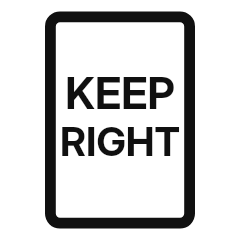
14. Where is this sign normally installed?
Show answer
Answer A: At an island or other obstruction in the roadway, to show which side traffic must take
It is placed at a divider, island or fixed obstruction so that drivers approaching it know without hesitating which side to pass on.
-
15. A sign at the approach to a bridge reads WEIGHT LIMIT 10 TONS. What does the figure set?
Show answer
Answer B: The heaviest vehicle the bridge may legally carry
A weight limit sign is a regulation based on what the structure can bear, and it applies to the loaded weight of the whole vehicle.
-
16. You have stopped at a stop line but parked cars hide the cross street. What comes next?
Show answer
Answer C: Edge forward to where you can see, stopping again if needed
The legal stop at the line is only the first stop; you then move up slowly to a point where you can see, and stop again if traffic requires it.
-
17. You turn the wheel but the front of the vehicle keeps sliding straight ahead on a slippery road. What should you do?
Show answer
Answer C: Ease off the accelerator and reduce the steering angle until the front tires grip again
A front-wheel skid means the tires are asking for more grip than the surface can give. Less speed and less steering angle let them regain traction.
-
18. You are about to slow down sharply for a turn. Which check comes first?
Show answer
Answer A: A look in the mirror to see how close the traffic behind you is
Any hard slowing needs a mirror check first, because the driver behind is the one who has to react to it.
-
19. What is the safest way to deal with a vehicle sitting in your blind spot?
Show answer
Answer A: Slow a little or move ahead so that it is no longer beside you
You cannot control the other driver, but you can change your own speed so that the vehicle is no longer hidden beside you.
-
20. Warning signs such as stop ahead, yield ahead and signal ahead are installed mainly where
Show answer
Answer B: the traffic control device cannot be seen from far enough away
These advance warning signs are used when a crest, curve or obstruction keeps the stop sign, yield sign or signal from coming into view in time for a driver to react.
-
21. In Mississippi, a child under what age must be secured in a child passenger restraint device?
Show answer
Answer B: Under 4 years old
Mississippi requires children under four years old to ride in a child passenger restraint device meeting applicable safety standards.
-
22. While driving on a Mississippi Regular Learner's Permit, who must occupy the seat next to the permit holder?
Show answer
Answer B: A licensed driver at least 21 years old
The permit allows driving only when a licensed driver aged 21 or older is physically occupying the seat beside the permit holder.
-
23. How may a Mississippi driver present proof of insurance at a traffic stop?
Show answer
Answer A: On paper or as an electronic image shown on a phone or other device
Mississippi expressly allows proof of insurance to be shown as an electronic image on a cellular phone or any other type of electronic device.
-
24. You are the second vehicle waiting to turn left on a green ball. Where should you wait?
Show answer
Answer A: Behind the stop line, until the first vehicle has actually turned
Only the lead vehicle should move into the intersection to wait; a second vehicle inside it is likely to be stranded there when the light changes.
-
25. Which pair of documents does Mississippi accept as the two required proofs of identification?
Show answer
Answer C: A social security card and a certified birth certificate
Mississippi requires a social security card and a certified birth certificate as the two proofs of identification.
-
26. A tractor-trailer is backing slowly across the roadway to enter a loading dock. What should you do?
Show answer
Answer C: Stop and wait until the truck has finished the maneuver
A backing truck driver has a very limited view and the trailer can swing unexpectedly. Trying to squeeze past in either direction risks being crushed.
-
27. A sign at the intersection prohibits U-turns, but the opening looks wide and clear. What may you do?
Show answer
Answer B: Obey the sign and turn around somewhere else
A prohibition applies whatever the traffic looks like at that moment, usually because of sight distance or conflicts you cannot see from the lane.
-
28. Some crosswalks are marked with two transverse lines and others with a row of wide bars laid along the direction of travel. Why is the second pattern used?
Show answer
Answer B: It is far easier for an approaching driver to see
Longitudinal bar patterns are used where extra visibility is wanted, such as an uncontrolled crossing or one near a school, because they show up much better from a car.
-
29. On which Mississippi road may a driver meeting a stopped school bus in the opposing roadway continue without stopping?
Show answer
Answer B: A divided highway of four or more lanes carrying traffic both ways
Mississippi excuses the stop only on a divided highway of four or more lanes, whether or not there is a median or turn lane, that permits at least two lanes of traffic to travel in opposite directions.
-
30. Once you are moving, which way of using a navigation device costs you the least attention?
Show answer
Answer B: Listening to the spoken directions
Voice guidance lets you keep your eyes on the road, while anything that needs the screen takes glances that add up over a trip.