
Mississippi DPS Permit Practice Test 10
Test 10 of 10. Pick an answer for each question to see if it is right and why; your score appears at the end. You need 24 correct answers to pass, the same ratio as the real Mississippi test.

- Questions30
- Correct to pass24
- Passing score80%
- Minimum age15 years
-
1. What is the safe way to carry a dog in a car?
Show answer
Answer C: In a secured crate, or in a harness attached to a seat belt anchor
An unrestrained animal distracts the driver and becomes a heavy projectile in a crash, so it should be crated or harnessed.
-
2. Permanent signs must be retroreflective or lighted so that
Show answer
Answer A: they show the same shape and color at night as by day
Retroreflective sheeting throws headlight light back to the driver, so a sign keeps its daytime shape and color after dark.
-
3. Three Mississippi children who need booster seats ride in a car whose rear seat has only two lap and shoulder belts. What does the law require?
Show answer
Answer A: Only the two children in the lap and shoulder belt seats need boosters
Where more than two children who need boosters travel and the rear seat has only two lap and shoulder belts, only the children in those seats need a booster; the others may use a lap belt.
-
4. Someone stops drinking heavily at two in the morning and drives to work at eight. What is true?
Show answer
Answer A: They may still be impaired and over the limit
The body removes alcohol at a slow, fixed rate, so a heavy night can leave a driver impaired well into the next morning no matter how they feel.
-
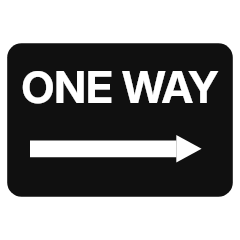
5. A driver disregards this sign and turns so as to travel against the direction it establishes. What is the immediate danger?
Show answer
Answer D: The driver will face traffic head on, because every lane comes the other way
Turning against the established direction puts the vehicle nose to nose with all the traffic on that street, which is why the mistake has to be corrected at once.
-
6. A wheel comes off your car while you are driving. What should you do?
Show answer
Answer A: Hold the wheel firmly, ease off the gas and steer gently to the shoulder
A firm grip and a gradual slowing keep the vehicle straight, while hard or sudden braking makes a damaged corner pull the car out of line.
-
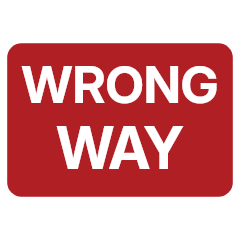
7. This sign comes into view ahead of a driver who has already started along a ramp. What should the driver do?
Show answer
Answer B: Pull clear where it is safe, then turn around and leave the ramp traveling properly
The driver is traveling against the legal flow, so the safest response is to stop clear of the lanes, turn the vehicle around and get off the ramp before meeting traffic head on.
-
8. How do strong emotions affect driving?
Show answer
Answer B: They narrow your attention and make risky decisions more likely
Anger, worry and excitement all take attention away from the driving task and push drivers toward decisions they would not normally make.
-
9. When should most of your braking for a turn be finished?
Show answer
Answer B: Before you begin to turn the wheel
Slow to the right speed before the turn begins; braking hard while turning uses up the grip the tires need for steering.
-
10. How many hours of observed driving must the Mississippi affidavit signed by a parent, teacher or guardian certify?
Show answer
Answer C: 50 hours
Mississippi requires an affidavit stating that the signer witnessed the applicant operate a motor vehicle for at least 50 hours and attesting to the applicant's proficiency.
-
11. Enhanced reference location markers differ from ordinary mileposts in that they
Show answer
Answer B: carry the route number and a mileage figure to the tenth of a mile
An enhanced reference location marker adds the route designation and carries the mileage to a tenth, so the point named is far more precise than a plain milepost.
-
12. The center line beside your lane is a broken yellow line. What does it allow?
Show answer
Answer D: You may cross into the opposing lane to pass when it is safe and clear
A broken yellow center line marks a passing zone where traffic in that direction may cross into the opposing lane to pass when the way ahead is clear.
-
13. Mississippi requires a tag light. From how far away must it make the license plate legible at night?
Show answer
Answer A: Sixty feet
Mississippi requires a tag light that makes the letters and numerals of the rear plate visible at sixty feet at night.
-
14. What does a marked crosswalk tell a driver approaching a corner?
Show answer
Answer D: Where pedestrians are expected to cross and must be given way
Crosswalk markings show pedestrians where to cross and warn drivers to yield to anyone using the crossing.
-
15. Once you have parallel parked, how close to the curb should your wheels be?
Show answer
Answer C: Within the distance your state allows, commonly 12 to 18 inches
Parking close to and parallel with the curb keeps the vehicle out of the traffic lane without damaging the tires; each state sets the exact maximum, usually 12 inches and 18 inches in some states.
-
16. A vehicle registered in Mississippi with aftermarket window film must carry a label certifying what minimum light transmittance?
Show answer
Answer C: 28 percent or more
Mississippi requires a windshield label certifying that all windows transmit 28 percent or more light, plus a tint compliance certificate and decal.
-
17. A Mississippi vehicle owner could not show an insurance card at a crash but was in fact insured. How long is there to send proof to the Driver Service Bureau?
Show answer
Answer D: Sixty days
Proof must reach the Driver Service Bureau's Records Division within sixty days of the accident, or the owner's license is suspended.
-
18. How many times may a Mississippi driver receive non-adjudication of a DUI offense?
Show answer
Answer B: Once only
Mississippi allows non-adjudication of a DUI only one time under any provision of law that authorizes it.
-
19. What makes a left turn protected rather than permissive?
Show answer
Answer B: Oncoming traffic is held by a red signal while you have a green arrow
A protected turn is one where the conflicting movements are stopped by their own signal, which is what the green arrow indicates.
-
20. A driver is following you far too closely and you have a turn coming up. How should you slow down for it?
Show answer
Answer B: Signal early and slow gradually well before the turn
Early signals and gentle braking give a tailgater the time and distance they have failed to leave for themselves.
-
21. Besides text messages, what else does Mississippi forbid a driver to do with a hand-held mobile telephone?
Show answer
Answer B: Access, read or post to a social networking site while driving
Section 63-33-1 prohibits accessing, reading or posting to a social networking site with a hand-held mobile telephone while driving.
-
22. Which use of a hand-held mobile telephone is prohibited while driving in Mississippi?
Show answer
Answer B: Writing, sending or reading a text message
Mississippi bans writing, sending or reading text messages and posting to social networking sites on a hand-held phone while driving; voice-operated and hands-free use is not covered by that ban.
-
23. Which Mississippi residents may be considered for a hardship driving privilege?
Show answer
Answer B: Residents aged 15 to 17 who already hold a learner's permit
Mississippi considers hardship driving privileges only for residents aged fifteen to seventeen who already hold a learner's permit.
-
24. How should a head restraint be adjusted?
Show answer
Answer D: So the top is at least as high as the back of your head and close behind it
A restraint set at head height and close behind limits how far the head snaps backward in a rear impact, which is what reduces neck injury.
-
25. You face a red light at an intersection that has no stop line and no marked crosswalk. Where must you stop?
Show answer
Answer C: Before entering the intersection
With no line and no crosswalk, the stopping point is the near edge of the intersecting roadway, close enough to see cross traffic but clear of it.
-
26. What is the highest maximum speed a Mississippi governmental entity may establish for a toll road it operates?
Show answer
Answer C: 80 mph
Mississippi lets the entity operating a toll road set the maximum speed for that road, provided the figure does not exceed 80 mph.
-
27. What may a married Mississippi applicant under eighteen present instead of a school attendance form?
Show answer
Answer D: A marriage license
Mississippi accepts a marriage license in place of the school attendance form from an applicant under eighteen who is married.
-
28. You park facing downhill on a one-way street where the curb is on your left. Which way do the front wheels go?
Show answer
Answer A: Left, toward the curb on that side
Standard practice follows the curb rather than the side of the road: facing downhill the wheels point into the curb so a rolling vehicle is stopped by it. States differ on whether this is legally required.
-
29. At an intersection where turning on a red arrow is not permitted, the signal shows a red left arrow next to a steady green ball. What may you do?
Show answer
Answer D: Go straight or turn right if permitted, but not left
An arrow controls only the movement it points to, so here the red arrow stops the left turn while the green ball still allows the other movements.
-
30. You leave your car so that its rear overhangs a marked crosswalk. What is wrong with that?
Show answer
Answer B: Pedestrians must step around it into the traffic lane
A crosswalk has to stay completely clear; anything sticking into it pushes people on foot out into the path of moving vehicles.