
Mississippi DPS Permit Practice Test 3
Test 3 of 10. Pick an answer for each question to see if it is right and why; your score appears at the end. You need 24 correct answers to pass, the same ratio as the real Mississippi test.
- Questions30
- Correct to pass24
- Passing score80%
- Minimum age15 years
-
1. You want to move into the right lane just as an entrance ramp joins the highway at that point. What is the better choice?
Show answer
Answer B: Wait until you are past the merge area so you do not squeeze the entering traffic
The merge area is where ramp traffic has to find a gap, so adding a lane change of your own into the same space creates a conflict.
-
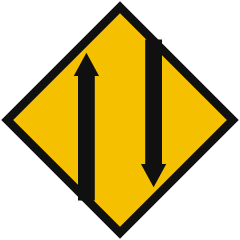
2. Which action becomes clearly more risky beyond this sign?
Show answer
Answer A: Using the left side of the roadway to overtake
With vehicles coming the other way on the same pavement, overtaking on the left needs enough clear road to pull out, pass and return, which is often not available.
-
3. You are traveling beside another vehicle on a multilane highway at nearly the same speed. Why is this a poor position?
Show answer
Answer B: You may be sitting in that driver's blind spot with nowhere to go if they move over
Driving alongside removes your side escape route and often puts you where the other driver cannot see you. Speed up or drop back to open space beside you.
-
4. Which vehicle must stop at every Mississippi railroad crossing even when no train is coming and no signal is operating?
Show answer
Answer A: A school bus carrying even one child
Mississippi requires a school bus carrying even one child, a vehicle for hire carrying passengers, and a vehicle carrying explosives or flammable liquids to stop at all railroad crossings.
-
5. How far from a stopped Mississippi school bus with flashing red lights or an extended stop arm must you stop?
Show answer
Answer B: At least 10 feet
Mississippi law requires a complete stop at least ten feet from the bus, held until the children have crossed and the bus resumes motion with its lights off and stop arm retracted.
-
6. A ball rolls into the street from between parked cars ahead of you. What should you expect and do?
Show answer
Answer A: Expect a child to follow it and be ready to stop
A ball is usually followed by a child who is watching the ball and not the traffic. Slow down and be prepared to stop immediately.
-
7. You are stopped in slow traffic and a motorcycle comes up between the lanes. What should you do?
Show answer
Answer D: Hold your position and avoid any sudden lane change
The danger to a rider between lanes comes from a vehicle moving sideways without warning, so staying predictable is what protects them.
-
8. Which clue tells you that a parked vehicle is about to pull into traffic?
Show answer
Answer D: Exhaust smoke, brake lights, front wheels turned out or a driver in the seat
A running engine, lit brake lights, turned wheels or a person behind the wheel all mean the vehicle may move. Slow down and give it room.
-
9. What does Mississippi law say about state assessments on a texting while driving penalty?
Show answer
Answer C: No state assessments may be imposed or collected for the violation
Section 63-33-1 states that no state assessments shall be imposed or collected for a texting while driving violation.
-
10. When is a child ready to use a vehicle seat belt without a booster seat?
Show answer
Answer A: When the lap belt lies across the upper thighs and the shoulder belt crosses the chest
Belt fit, not age, decides readiness. Until the child is tall enough for the lap belt to sit on the thighs and the shoulder belt on the chest, a booster is needed.
-
11. What does the Driver Service Bureau charge for a Mississippi Regular Learner's Permit?
Show answer
Answer B: $7.00
Mississippi lists the Regular Learner's Permit at $7.00, well below the $24.00 charged for a four-year Class R license.
-
12. On a Mississippi four-lane highway, what does the law require when an emergency vehicle with activated lights or siren is stopped beside the road?
Show answer
Answer A: Merge into the lane away from the emergency vehicle when it is safe, and otherwise slow down and prepare to stop
Mississippi requires drivers to merge into the lane away from a stopped emergency vehicle when it is safe, and to slow down and prepare to stop when merging is not safe.
-
13. Smoke and flames appear from the engine compartment after you stop. What should you do?
Show answer
Answer A: Get everyone well away from the vehicle first, and then call the fire service
A vehicle fire can spread within seconds, so people come out first and firefighting is left to the fire service.
-
14. A small plaque mounted under this sign shows a numeral such as 2 or 3. What does that numeral report?

Show answer
Answer A: How many sets of tracks the crossing carries
The plaque states the number of tracks at that location, which is a warning that a second train may be running on another track behind the first.
-
15. A Mississippi applicant under eighteen presents a school attendance form. How long is that form valid?
Show answer
Answer B: Thirty days
Mississippi will not accept a school attendance form that is more than thirty days old.
-
16. What is true about driving away from a crash you were involved in?
Show answer
Answer B: It is a serious offense, even if the other driver has driven away too
Leaving the scene is a criminal offense in every state, and the behavior of the other driver does not excuse it.
-
17. Mississippi's table of speed limits for passenger automobiles expressly includes which other vehicles?
Show answer
Answer D: Half-ton trucks that are running unloaded
The Mississippi speed table covers passenger automobiles including half-ton trucks that are unloaded; loaded trucks and school buses have their own limits.
-
18. You stop behind another vehicle at a traffic light. How much space should you leave?
Show answer
Answer D: Enough to see where its rear tires touch the pavement
Seeing the rear tires on the road leaves room to steer around the vehicle if it stalls, and gives a cushion if you are struck from behind.
-
19. The light turns yellow when your front wheels are already past the stop line inside the intersection. What should you do?
Show answer
Answer B: Keep going and clear the intersection without speeding up
Once you are legally in the intersection the safest and correct action is to continue through and clear it, without accelerating.
-
20. Which vehicle falls outside Mississippi's definition of a passenger motor vehicle for seat belt purposes?
Show answer
Answer D: A moped
Mississippi defines a passenger motor vehicle as one designed to carry fifteen or fewer people including the driver, and excludes mopeds, trailers, all-terrain vehicles and motorcycles that are not autocycles.
-
21. Under Mississippi law, what may a driver do with a hand while using a voice-operated or hands-free device?
Show answer
Answer C: Activate, deactivate or initiate a feature or function
Mississippi defines a voice-operated or hands-free device as one used without either hand except for a single narrow purpose set out in the statute.
-
22. Where must a Mississippi driver stop when a crossing gate is lowered or a signal is flashing at a railroad crossing?
Show answer
Answer D: Within fifty to ten feet of the outer rail of the crossing
Mississippi requires every driver to stop within fifty to ten feet of the outer rail whenever a gate is down, a signal is flashing, a stop sign is posted, a flag person signals or a train is approaching.
-
23. Where is a U-turn generally the most reasonable choice?
Show answer
Answer B: At an intersection where it is permitted and you can see well both ways
A U-turn needs a legal place and a long clear view in both directions, which is why a permitted intersection with open sight lines is the usual choice.
-
24. Heavy trucks have worn deep ruts into a highway lane and rain has filled them. What is the danger?
Show answer
Answer D: Water collects in them, so the tires can lose contact with the road
Ruts hold standing water long after the rest of the lane has drained, which makes them the most likely place to start hydroplaning.
-
25. Travelling at about 55 mph on dry pavement, roughly how much room does an average car need to perceive, react and stop?
Show answer
Answer D: About 300 feet, close to the length of a football field
Reaction distance plus braking distance at 55 mph comes to roughly 300 feet on good dry pavement, and considerably more on a wet or loose surface.
-
26. What must the Mississippi Department of Public Safety keep for every citation issued under the texting while driving law?
Show answer
Answer A: Records including the operator's age and race and whether a crash occurred
The statute directs the Department of Public Safety to record the operator's age and race, any additional traffic violation, and whether a crash or damage occurred.
-
27. You are slowing to turn right at an intersection and a bicyclist is riding beside your right side in a bike lane. What should you do?
Show answer
Answer D: Let the bicyclist go through the intersection before you begin the turn
Turning across the path of a bicyclist who is going straight causes the classic right-hook crash. The rider continuing straight has the right-of-way over your turn.
-
28. Your right wheels drop off the edge of the pavement onto a soft shoulder. What should you do?
Show answer
Answer C: Ease off the accelerator, hold the wheel straight and steer back gently once you have slowed
Yanking the wheel while the tires are pressed against a pavement lip can throw the vehicle across the road, so slow down first and then make a gentle correction.
-
29. Another vehicle is passing you on a two-lane road. What should you do with your speed?
Show answer
Answer A: Hold your speed or ease off slightly to shorten the pass
Speeding up strands the passing driver in the oncoming lane, while a steady speed or a slight lift lets the pass finish quickly and safely.
-
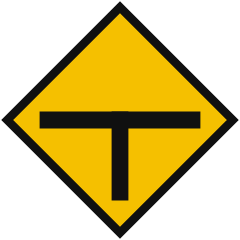
30. What must a driver be prepared to do at the point this sign refers to?
Show answer
Answer D: Turn left or right, because the road being traveled ends there
The road ends at another roadway, so the driver must slow, give way to traffic on the through road and turn in one direction or the other.