
Mississippi DPS Motorcycle Practice Test 35
- Questions30
- Correct to pass24
- Passing score80%
- Minimum ageSee note
-
1. An exit ramp is separated from the highway by a triangle of pavement painted with white stripes. What may you do there?
Show answer
Answer C: Nothing; keep off it and choose either the lane or the ramp
The striped area between a ramp and the through lanes is not for driving, stopping or last-second changes of direction.
-
2. How recent must each of the two proofs of residency be when applying for a Mississippi driver's license?
Show answer
Answer B: No more than 60 days old
The Driver Service Bureau will not accept a proof of residency that is more than sixty days old.
-
3. On a Mississippi four-lane highway, what does the law require when an emergency vehicle with activated lights or siren is stopped beside the road?
Show answer
Answer A: Merge into the lane away from the emergency vehicle when it is safe, and otherwise slow down and prepare to stop
Mississippi requires drivers to merge into the lane away from a stopped emergency vehicle when it is safe, and to slow down and prepare to stop when merging is not safe.
-
4. You are the first to arrive at a crash on a rural road. What should you do first?
Show answer
Answer C: Park well clear of the scene, put on your hazard lights and call for help
Getting trained help on the way and keeping the scene visible does more good than anything an untrained bystander can do.
-
5. A black and white regulatory sign facing traffic at a divided section reads KEEP LEFT. What does it require?
Show answer
Answer D: Passing the island or obstruction on its left side
Keep Left is posted at an island or obstruction that traffic must pass on the left, which is the opposite of the far more common Keep Right situation.
-
6. Which part of the body operates the gearshift lever?
Show answer
Answer B: The left foot
The gearshift lever sits ahead of the left footrest and is moved up or down with the left foot.
-
7. You are ready to pull out of a parallel parking space into the traffic lane. What should you do?
Show answer
Answer C: Signal, check the mirror and blind spot, and wait for a gap
A driver leaving a parking space must yield to traffic already in the lane, so signal, look for the gap and only then move out.
-
8. You have stopped on the shoulder of a highway and want to rejoin the traffic. What is the correct way?
Show answer
Answer D: Signal, build up speed along the shoulder, then merge into a gap
Entering a fast lane at a slow speed is what causes the conflict, so the shoulder is used to gain speed before the merge in the same way as an acceleration lane.
-
9. Where should a passenger sit on the motorcycle?
Show answer
Answer A: As far forward as possible without crowding the operator
Sitting well forward keeps the passenger weight close to the center of the motorcycle, which helps it handle closer to normal.
-
10. You are riding in the right hand lane of a freeway and vehicles ahead are merging on from an entrance ramp. What is the best response?
Show answer
Answer C: Change lanes if you safely can, or adjust speed to open a gap for them
Merging drivers are looking over a shoulder for a gap and easily miss a motorcycle, so the rider makes room rather than waiting to be seen.
-
11. Partway through a ride, a control starts to feel different from the way it normally feels. What is the right response?
Show answer
Answer B: Stop somewhere safe and find out what has changed before riding further
A change in feel is usually the first warning of a failing cable, a leaking brake or a loose fastener, and it is far cheaper to check at the roadside than to discover in traffic.
-
12. Which common non-prescription medicine is most likely to make a driver drowsy?
Show answer
Answer C: A cold or allergy remedy containing an antihistamine
Antihistamines in cold and allergy remedies are a leading cause of drowsiness behind the wheel, which is why the label carries a warning.
-
13. When should gear changes for a turn be completed?
Show answer
Answer A: Before entering the turn, so the machine stays settled through it
A clumsy shift while leaned over can jerk the rear wheel and break traction, so the right gear should be selected before the lean begins.
-
14. Why can a mild afternoon still chill a rider dangerously on the highway?
Show answer
Answer B: Riding speed creates a wind chill well below the air temperature
Air moving over the body at highway speed strips heat far faster than still air, so a comfortable temperature at a standstill can cause serious chilling in an hour of riding.
-
15. How should tire pressure be checked and set?
Show answer
Answer B: When the tires are cold, set to the pressure specified by the vehicle manufacturer
Driving heats the air and raises the reading, and the sidewall number is a maximum rather than a recommendation, so check cold and use the figure on the vehicle placard or in the owner's manual.
-
16. What is the correct sequence for shifting into a higher gear?
Show answer
Answer C: Roll off the throttle, squeeze the clutch, lift the lever, ease the clutch out
Closing the throttle as the clutch comes in, then easing the clutch out as the throttle is reopened, keeps the change smooth and the chassis settled.
-
17. Why should a rider reduce speed at night even on a familiar road?
Show answer
Answer C: So the stopping distance stays inside the distance the headlight lights up
At night you can only react to what the headlight shows, so keep your speed low enough that you can stop within the lit distance ahead.
-
18. You are riding a shaded back road in autumn and reach a mat of wet leaves covering the pavement. What should you expect?
Show answer
Answer D: Traction can be nearly as poor as ice, so slow down before you reach them
Wet leaves are slick and they hide whatever is underneath, so reduce speed before the patch and cross it upright without braking or turning.
-
19. You are driving along a street lined with parked cars. What should you watch for?
Show answer
Answer B: Doors opening, vehicles pulling out and pedestrians stepping from between cars
Parked cars hide people and can move without warning. Keep as much space from them as you safely can and cover the brake.
-
20. You are riding through a curve behind another rider in your group. Which line should you take?
Show answer
Answer A: The line your own machine and your own speed require
Riders enter a curve at different speeds and on different machines, and copying somebody else's line can put you wide or into the wrong part of the lane.
-
21. On the Interstate system, what do the odd-numbered one and two digit routes have in common?
Show answer
Answer D: They run mainly north and south
Odd numbers are given to north and south Interstates and even numbers to east and west ones, with the numbers rising toward the north and the east.
-
22. You must park on soft ground or on asphalt softened by heat. What should you do about the sidestand?
Show answer
Answer A: Put a flat, firm object under the stand to spread the load
A sidestand concentrates the weight of the machine onto a very small area, and on soft ground it sinks in until the motorcycle falls over.
-
23. A large insect splatters on your face shield and blocks part of your view. What should you do?
Show answer
Answer D: Keep control, look through a clear part, and clean it at the next stop
Taking a hand off the bars or riding with your eyes closed is far more dangerous than a partly obscured view, so keep riding and clean the shield when you are stopped.
-
24. How does braking distance change if you double your speed?
Show answer
Answer D: It grows much more than twice as long
Braking distance increases with the square of speed, so doubling speed roughly quadruples the distance needed to stop.
-
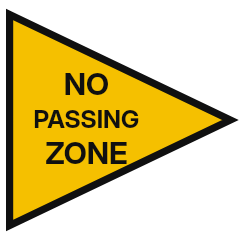
25. Why would a restriction like this one be applied to a stretch of road?
Show answer
Answer A: Because there is not enough visible road ahead to complete a pass safely
Limits on overtaking are set where a hill, a curve or an obstruction leaves too little sight distance for a driver to pull out, pass and return before meeting oncoming traffic.
-
26. On a regulatory sign, what does a red circle with a diagonal slash drawn over a symbol mean?
Show answer
Answer D: The movement or action shown by the symbol is prohibited
A red circle with a diagonal slash is the standard way of showing that the movement pictured inside it, such as a U-turn or a right turn, is not allowed.
-
27. A yellow diamond shows an arrow bent into a series of reversing turns. What does it warn about?
Show answer
Answer A: Three or more changes of direction close together
The winding road sign replaces a string of separate curve signs where several bends follow one another with only short straights between them.
-
28. Which clue suggests that a car waiting at a side street is about to pull out in front of you?
Show answer
Answer B: The front wheels are turned and the car is creeping forward
Turned wheels and a slow creep forward are the strongest signs that a driver is about to move, so cover the brakes and be ready to change your lane position.
-
29. What actually lowers the amount of alcohol in a person's blood?
Show answer
Answer D: The passage of time
The body eliminates alcohol at its own steady rate, so only time reduces blood alcohol. Coffee or a cold shower may make a person feel more awake while still impaired.
-
30. On a busy multilane highway, where is the best place to travel?
Show answer
Answer B: In a gap in the traffic, with space open on both sides
Travelling in a gap keeps escape routes open on both sides, while riding alongside other vehicles removes the room you would need to swerve.