
Mississippi DPS Permit Practice Test 38
- Questions30
- Correct to pass24
- Passing score80%
- Minimum age15 years
-
1. You are approaching an uncontrolled intersection on a residential street where parked cars hide the cross street. What is the correct approach?
Show answer
Answer B: Slow enough to stop and creep out until you can see
Without a sign or signal you still have to be able to yield, and you cannot yield to traffic you have not seen.
-
2. The signal turns green as you approach an intersection. What is the safest practice?
Show answer
Answer B: Look left, then right, then left again, and make sure the intersection is clear before entering
A green light gives permission but does not guarantee the intersection is empty, and a quick scan catches a vehicle running the red or a pedestrian still crossing.
-
3. Your vehicle does not have antilock brakes and you must stop quickly on a slippery road. What is the correct technique?
Show answer
Answer B: Apply the brakes firmly without locking the wheels, releasing slightly if they lock
Locked wheels slide and cannot steer. Squeezing the brakes to just short of lockup, and easing off if they lock, gives the shortest stop with control.
-
4. Which of these would appear as a symbol on a blue general service sign?
Show answer
Answer A: A hospital
General service signs cover facilities such as hospitals, fuel, food, lodging, camping, telephones and rest areas, all shown in white on blue.
-
5. A sign at the intersection prohibits U-turns, but the opening looks wide and clear. What may you do?
Show answer
Answer B: Obey the sign and turn around somewhere else
A prohibition applies whatever the traffic looks like at that moment, usually because of sight distance or conflicts you cannot see from the lane.
-
6. When does Mississippi's school zone speed limit apply?
Show answer
Answer B: During recess and while children arrive or leave at opening and closing hours
The Mississippi school zone sign states that the reduced limit applies when passing a school during recess or while children are arriving at or leaving school during opening and closing hours.
-
7. How does being tired change your total stopping distance?
Show answer
Answer A: It lengthens it, because you take longer to notice and react
Fatigue stretches perception and reaction time, and every extra fraction of a second is added distance before the brakes even begin to work.
-
8. How should a head restraint be adjusted?
Show answer
Answer D: So the top is at least as high as the back of your head and close behind it
A restraint set at head height and close behind limits how far the head snaps backward in a rear impact, which is what reduces neck injury.
-
9. Traffic in your lane is backed up and the paved shoulder looks clear. May you drive along it to get past?
Show answer
Answer C: No, the shoulder is not a travel lane
Passing must be done within the roadway; driving on the shoulder to get around traffic is prohibited and surprises anyone entering from the right.
-
10. At an intersection where turning on a red arrow is not permitted, the signal shows a red left arrow next to a steady green ball. What may you do?
Show answer
Answer D: Go straight or turn right if permitted, but not left
An arrow controls only the movement it points to, so here the red arrow stops the left turn while the green ball still allows the other movements.
-
11. A center lane is bordered by a solid yellow line on the outside and a broken yellow line on the inside, with left-turn arrows painted in it. How may you use that lane?
Show answer
Answer A: Only to make a left turn or to prepare for one from either direction
That marking identifies a two-way left turn lane, which may only be used for left turns or to prepare for a left turn and never for travel or passing.
-
12. You are pulling out of a farm entrance onto a rural highway. What is your obligation?
Show answer
Answer C: Yield to every vehicle already on the highway before you enter the roadway
A driver entering a highway from a private road or driveway yields to every vehicle already on the highway.
-
13. About how far behind a tractor-trailer does the driver's rear blind spot reach?
Show answer
Answer C: Around 30 feet
The area behind a large truck is hidden for roughly 30 feet, so a driver tucked in there cannot be seen at all.
-
14. You are approaching a yield sign and no other vehicle is anywhere in sight. What does the sign require?
Show answer
Answer A: Slow down and be ready to stop, but stop only if needed
A yield sign requires you to slow and give way, and to stop only when traffic or pedestrians make stopping necessary.
-
15. At what age may a first-time Mississippi applicant apply directly for a Regular Driver's License instead of starting with a learner's permit?
Show answer
Answer B: 17 years old
An applicant who first applies at 17 or older may apply directly for a Class R license and may take the computerized exam the same day.
-
16. How should a turn at an intersection be taken on a wet road?
Show answer
Answer C: Slow earlier than usual and steer smoothly through the corner
Wet pavement leaves less grip, so the speed must come off before the turn and the steering must be gentle enough not to break traction.
-
17. Another driver takes a right of way that was legally yours. What should you do?
Show answer
Answer A: Give way to the other driver and avoid the crash, whatever the law says
Right of way is something you give, not something you take, and being in the right is no protection in a collision.
-
18. Is it acceptable to drive far below the flow of traffic on an open highway?
Show answer
Answer B: No, driving too slowly can obstruct traffic and create a hazard
Traffic that is much slower than the surrounding flow forces other drivers into sudden braking and unnecessary passing maneuvers, and impeding traffic is itself a violation.
-
19. How should a pregnant driver or passenger wear a seat belt?
Show answer
Answer A: Lap belt below the belly across the hips, shoulder belt across the chest
A properly worn belt protects both mother and baby. The lap portion goes low under the belly, snug across the hip bones, and the shoulder belt crosses between the breasts.
-
20. What is the main danger when you back out of an angle parking space?
Show answer
Answer A: Parked vehicles beside you hide the traffic coming along the aisle
You have to edge out blind past the vehicles on either side, so back very slowly and be ready to stop as soon as any part of the aisle comes into view.
-
21. Your light is green but the traffic beyond the intersection is stopped and there is no room on the far side. What should you do?
Show answer
Answer A: Wait behind the line until you can clear the far side
Entering an intersection you cannot clear blocks the cross traffic when their signal turns green, so you wait behind the line.
-
22. A farm implement ahead of you on a two-lane road is wider than its own lane. What should you do?
Show answer
Answer D: Hang back until you can see past it and pass only with a clear road
Wide equipment hides the road ahead and may extend farther across the center line than it appears, so the pass needs more room and a much better view.
-
23. The sign over the leftmost lane reads LEFT LANE MUST TURN LEFT. You are in that lane and want to go straight. What should you do?
Show answer
Answer C: Move out of the lane before the intersection if it is safe
A mandatory movement lane control sign makes the turn compulsory for that lane, so a driver who wants another movement must change lanes in advance.
-
24. A car is coming straight at you in your lane and there is no time for it to move back. What should you do?
Show answer
Answer A: Brake, sound the horn and steer to the right, toward the shoulder or ditch
Steering right takes you away from the other vehicle even if its driver corrects course, and the shoulder or ditch is survivable.
-
25. Where is a strong crosswind most likely to hit you suddenly?
Show answer
Answer D: Coming out of a tunnel or a cut onto an open bridge
Gusts arrive the moment you leave shelter, which is why bridge approaches and the ends of cuts and tunnels catch drivers out.
-
26. A driver behind you on a two-lane road clearly wants to pass. Why should you not wave that driver past?
Show answer
Answer B: You cannot see the whole road ahead for them and they may rely on your signal
Waving another driver out invites them to trust your judgment of a road you cannot see well enough, and the decision to pass belongs to the driver making it.
-
27. An out-of-state student attending a Mississippi university may drive using what credential?
Show answer
Answer A: The valid driver's license issued by the student's home state
Mississippi lets out-of-state college students drive on their home state license, the same allowance it gives non-resident military families.
-
28. What does this sign tell a driver about the road ahead?
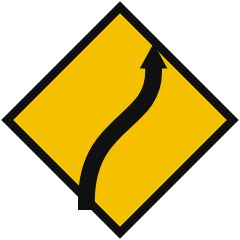
Show answer
Answer A: The roadway changes direction ahead, so speed should be reduced before reaching it
It gives advance notice of a change in alignment so the driver can slow down before entering, since braking inside a bend uses up grip that is needed for steering.
-
29. You approach an intersection where the signal is flashing yellow. What should you do?
Show answer
Answer D: Slow down and cross the intersection with caution
A flashing yellow signal warns you to slow down and cross with care; it does not require a stop, but it does not give you priority either.
-
30. A Mississippi crash injures nobody. Above what amount of apparent property damage must it still be reported to law enforcement?
Show answer
Answer C: $500
Mississippi requires an immediate report to law enforcement when an accident involves injury, death, or apparent property damage exceeding $500.