
Mississippi DPS Permit Practice Test 27
- Questions30
- Correct to pass24
- Passing score80%
- Minimum age15 years
-
1. When should most of your braking for a turn be finished?
Show answer
Answer B: Before you begin to turn the wheel
Slow to the right speed before the turn begins; braking hard while turning uses up the grip the tires need for steering.
-
2. Loose gravel has been swept into the middle of your lane on a downhill bend. Which controls are affected most?
Show answer
Answer D: Steering and braking, since the loose stones roll under the tires
Gravel rolls between rubber and pavement, so the tires can neither turn the vehicle nor slow it as they would on a clean surface.
-
3. A law enforcement officer is directing traffic and waves you forward while the signal facing you shows red. What should you do?
Show answer
Answer A: Follow the officer's direction and proceed
Directions given by an officer controlling traffic take priority over signals, signs and pavement markings.
-
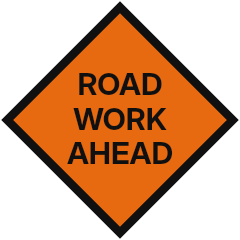
4. Beyond this sign, cones and temporary signs lead traffic along a path that does not agree with the lines painted on the pavement. Which one must the driver follow?
Show answer
Answer C: The temporary arrangement, because it replaces the permanent layout while the work lasts
Temporary traffic control set up for the work takes precedence over the permanent signs and markings, which no longer describe how the road is being used.
-
5. Some toll facilities use signs and markings with a purple background or a purple stripe. What do they identify?
Show answer
Answer D: Lanes reserved for vehicles with an electronic toll account
Purple is assigned to lanes and ramps restricted to vehicles with a registered electronic toll collection account, so drivers without one must stay out.
-
6. Where should a rear-facing infant seat never be placed?
Show answer
Answer C: In a front seat with an active passenger air bag
A deploying front air bag strikes the back of a rear-facing seat with enormous force. Rear-facing seats belong in the back seat.
-
7. What is the main limit of stability and traction control systems?
Show answer
Answer B: They cannot create grip that the tires and the road do not have
These systems manage the grip that exists. If you enter a curve too fast for the surface, no amount of electronics will hold the vehicle on the road.
-
8. What is the main function of the guide sign series?
Show answer
Answer D: To identify routes and lead road users to their destinations
Guide signs identify routes, name destinations and give distances, so drivers can navigate without stopping to consult a map.
-
9. At a railroad crossing with no gates and no flashing lights, the crossbuck is normally combined with which sign?
Show answer
Answer C: A yield sign, or a stop sign where an engineering study calls for one
At a passive crossing the crossbuck forms an assembly with a yield sign, or with a stop sign when an engineering study or engineering judgment supports it, so the driver knows who must give way to the train.
-
10. Your vehicle is stuck in deep snow and you run the engine for heat while waiting for help. What must you check?
Show answer
Answer C: That the exhaust pipe is clear of snow
Snow packed around the tailpipe pushes exhaust back into the cabin, and carbon monoxide can kill without warning. Clear the pipe and crack a window open.
-
11. A bicyclist is riding in the middle of a narrow travel lane ahead of you. What is the correct response?
Show answer
Answer D: Slow down and wait until you can pass with wide clearance, changing lanes if needed
A bicyclist has the same right to use the lane as a driver, and a narrow lane may not leave safe passing room, so wait for a gap that lets you move over and pass with a wide margin.
-
12. You are leaving a freeway at an exit that has a deceleration lane. Where should you slow down?
Show answer
Answer C: After you have moved fully into the exit lane
Braking in a through lane surprises the traffic behind you, so you move into the exit lane at highway speed and then slow down inside it.
-
13. How should speed and following distance be adjusted beyond this sign?
Show answer
Answer D: Cut speed and leave a longer gap, because traffic can stop without warning
Traffic in these areas stops and starts unexpectedly and there is little room to steer around a problem, so extra space is what prevents a rear-end collision.
-
14. You must stop for a train at a highway-rail crossing. Where should you stop?
Show answer
Answer B: Behind the stop line, gate or signal and well clear of the nearest rail
Stop behind the stop line, gate or flashing-light signal and well clear of the nearest rail, because a train overhangs its track by several feet on each side.
-
15. Besides its height, what else matters about a head restraint?
Show answer
Answer C: That it is close to the back of the head, and not far behind it
A restraint that sits far behind the head lets the head snap back before it is caught, so a small gap is important.
-
16. A driver stopped on suspicion of impaired driving refuses to take a chemical test. What happens?
Show answer
Answer D: A license penalty follows for the refusal itself
Under implied consent, holding a license means agreeing to testing, so a refusal brings its own suspension separately from anything the court decides.
-
17. When should you turn on your signal before a turn or a lane change?
Show answer
Answer C: Well before the maneuver, so other drivers have time to react
A signal is a warning to others, so it has to be given far enough ahead of the maneuver that drivers and pedestrians can adjust.
-
18. The lane control signal above your lane changes to a steady yellow X. What should you do?
Show answer
Answer A: Prepare to leave the lane, because it is about to be closed
A steady yellow X is the warning that the lane below it is about to close, giving drivers time to move over before the red X appears.
-
19. How long is the license suspension for a first offense DUI conviction in Mississippi for a driver 21 or older?
Show answer
Answer C: 120 days
A first offense DUI in Mississippi carries a 120-day suspension along with a fine of $250 to $1,000 and up to 48 hours in jail.
-
20. A pedestrian waiting at a curb faces a steady upraised hand. What does that indication mean?
Show answer
Answer A: Do not start to cross in that direction
A steady upraised hand forbids entering the crosswalk, while a flashing hand only forbids starting a new crossing.
-
21. Your vehicle has a blind spot warning light in the door mirror. What should that mean for your habits?
Show answer
Answer B: You still check the blind spot yourself, because the system can miss a rider
Blind spot systems are an aid, not a substitute, and a motorcycle or a bicycle can be missed or arrive faster than the sensor expects.
-
22. You arrive at an intersection with no signs, no signals and no markings at the same time as a vehicle on the road to your right. What must you do?
Show answer
Answer B: Yield to the vehicle on your right
At an uncontrolled intersection you must yield to a vehicle already in the intersection or approaching from your right.
-
23. In which situation should you increase your usual following distance?
Show answer
Answer B: On wet roads, at night, in fog, when towing a trailer, or when following a motorcycle
Reduced traction, reduced visibility, a heavier load and a vehicle that can stop faster than yours all require extra space to keep the same margin of safety.
-
24. Children are playing close to the edge of a residential street. What is the right speed choice?
Show answer
Answer D: Well below the limit, slow enough to stop for a sudden dash
Children can step out without warning, so the safe speed is the one that lets you stop within the distance you can see to be clear.
-
25. You back into an unattended parked car in a lot and cause visible damage. What must you do?
Show answer
Answer A: Try to find the owner, or leave a note with your name and contact details, and report the crash
Hitting an unattended vehicle carries the same duties as any crash. Leaving without identifying yourself is a hit-and-run offense.
-
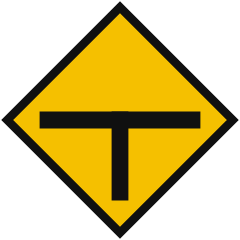
26. On which approach is this sign normally installed?
Show answer
Answer C: On the road that ends, far enough ahead for the driver to slow down
The warning belongs on the approach that terminates, placed early enough that the driver can lose speed and choose a direction before reaching the junction.
-
27. How far ahead should you normally be looking as you drive?
Show answer
Answer C: About 12 to 15 seconds ahead, well beyond the vehicle in front
Looking that far down the road lets you see a problem developing and slow smoothly, instead of discovering it in time only for hard braking.
-
28. You have a green light at a school crossing, but the crossing guard steps out and holds up a stop sign toward you. What must you do?
Show answer
Answer A: Stop, because the crossing guard controls this crossing and outranks the signal
Directions from a crossing guard or a police officer take priority over signals and signs.
-
29. You reach a stop-controlled intersection at the same time as a driver on your left, but that driver is already moving through the crossing. Who goes first?
Show answer
Answer C: The driver who is already inside the intersection
A vehicle already in the intersection has the right of way, and the rule about yielding to the right applies only before anyone has entered.
-
30. You have printed directions or paperwork you need to check. When should you read them?
Show answer
Answer C: Before you leave, or after you park
Reading takes eyes and mind off the road for far longer than any safe glance, and a light that changes while you read leaves you moving off blind.